The multitasking myth: the most confident filter the worst
A Stanford study in PNAS and longitudinal data from JAMA Network Open: frequent attention switching lastingly damages cognitive control.
 Jan Petr1 min read3 views
What the studies examined
This area rests on two pillars. The first is the classic Stanford University study (Ophir et al., 2009) in PNAS, comparing cognitive control in light and heavy media multitaskers. The second is a longitudinal study in JAMA Network Open (Nagata et al., 2025) mapping the effects of digital overload on wellbeing.
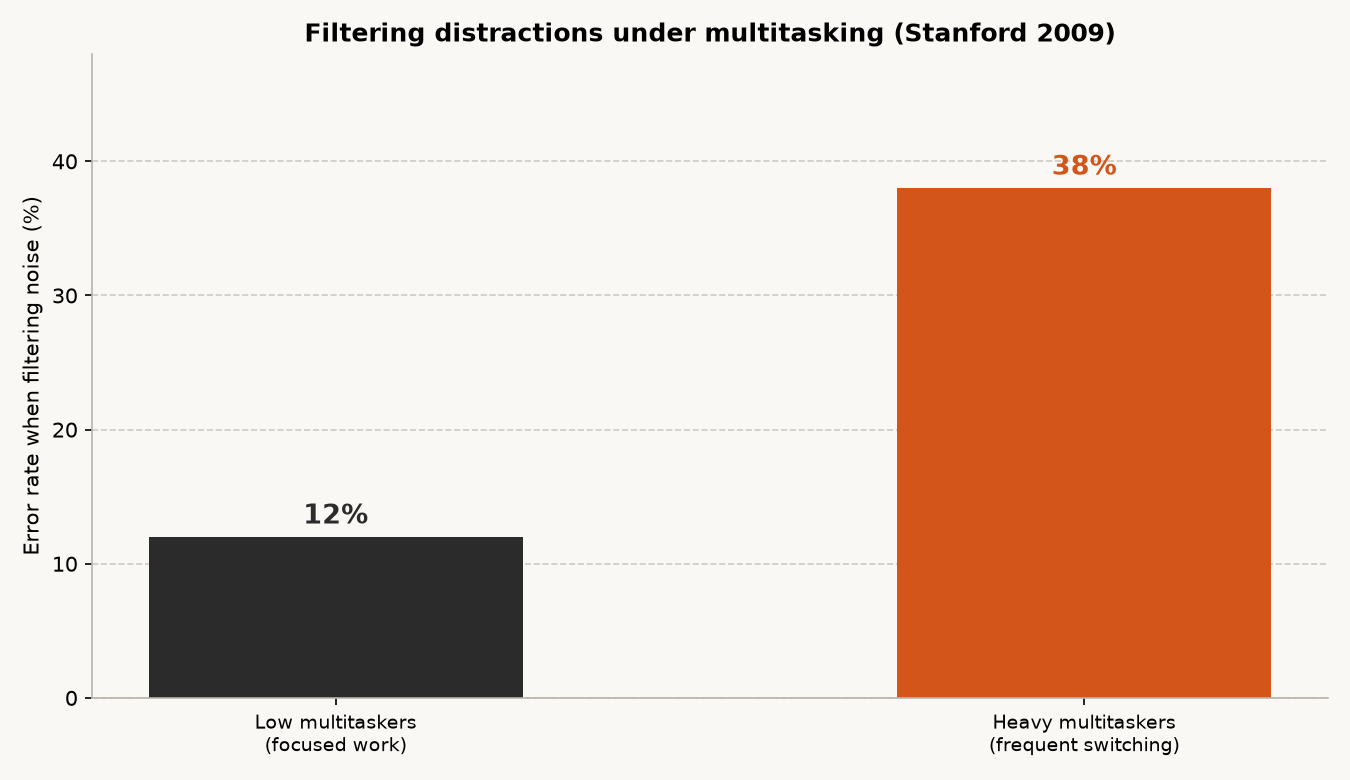
Heavy multitaskers make more than three times as many errors when filtering irrelevant noise.
Key findings
The multitasking myth
People who claim to be good at multitasking are in fact the worst at it. They chronically fail to ignore irrelevant stimuli, have weaker working memory and struggle to switch between tasks.
Fragmented attention
Instant AI answers and constant notifications train the brain for quick dopamine hits, destroying capacity for focused work.
Link to mental health
Longitudinal data confirm that difficulty sustaining attention and digital overload correlate with rising anxiety and depressive symptoms.
What to do about it
- Practise deep work blocks: 45 minutes, one task, notifications off.
- Use AI in dedicated blocks, not continuously as an interruption.
- Close unnecessary tabs before starting a demanding piece of writing.
Sources
Ophir, E., Nass, C., & Wagner, A. D. (2009). Cognitive control in media multitaskers. PNAS, 106(37), 15583–15587. doi.org/10.1073/pnas.0903620106
Nagata, J. M., et al. (2025). Social Media Use and Depressive Symptoms During Early Adolescence. JAMA Network Open, 8(5). doi.org/10.1001/jamanetworkopen.2025.11704
Comments
Loading comments…