Critical thinking at risk: what a study of 666 people revealed
Frequent, uncritical AI use weakens critical judgement. The culprit is not the technology but the passive acceptance of ready-made answers.
 Jan Petr1 min read4 views
What the study examined
A large quantitative study analysed the behaviour and cognitive patterns of 666 participants, looking at the relationship between AI use intensity, cognitive offloading and measured critical thinking ability.
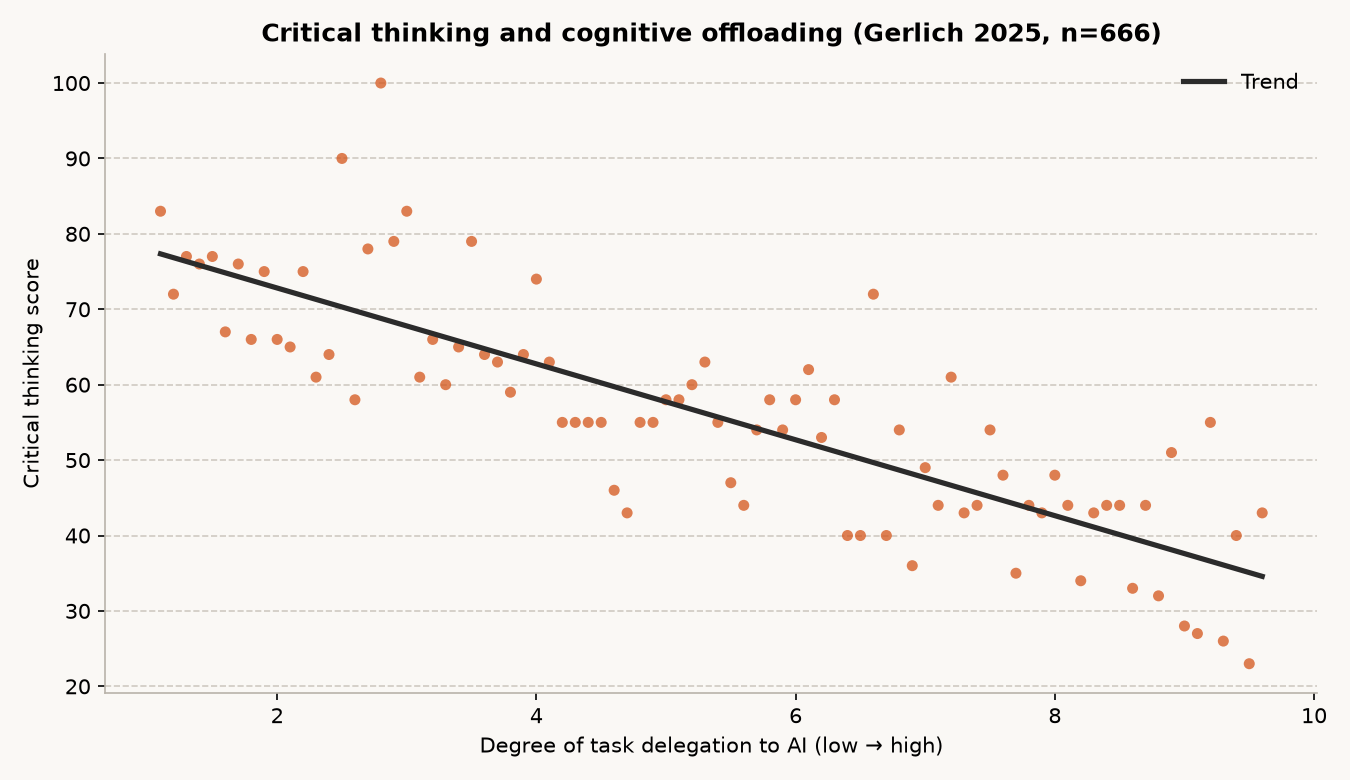
Each point is one respondent. The more tasks a person delegates to AI, the lower the critical thinking score.
Key findings
A proven negative relationship
The study confirmed a statistically significant negative correlation between AI use frequency and critical thinking test scores.
The causal mechanism
The decline is fully mediated by cognitive offloading. The steepest drop appears among people who use AI only to passively generate finished text and answers.
Loss of doubt
Heavy offloaders gradually lose the habit of verifying facts, seeking counter-arguments and approaching information with healthy scepticism.
What to do about it
AI is an excellent generator of plausible text, not an infallible source of truth. Treat it as an intelligent but unreliable intern.
- Make the model defend itself: „Find three weak points in your previous answer.“
- Ask for the opposition: „What are the strongest counter-arguments?“
- Verify the primary source for every fact you pass on.
Source
Gerlich, M. (2025). AI Tools in Society: Impacts on Cognitive Offloading and the Future of Critical Thinking. Societies, 15(1), 6. doi.org/10.3390/soc15010006
Comments
Loading comments…