Cognitive debt: what EEG showed about writing with ChatGPT
An MIT Media Lab experiment with 54 participants: AI-assisted writing cut brain connectivity by 65 % and recall of one own text by half.
 Jan Petr1 min read3 views
What the study examined
A neurological experiment at the MIT Media Lab worked with 54 participants writing essays, one half unaided and the other with ChatGPT. Brain activity was recorded with EEG, followed by tests of memory and sense of ownership of the finished text.
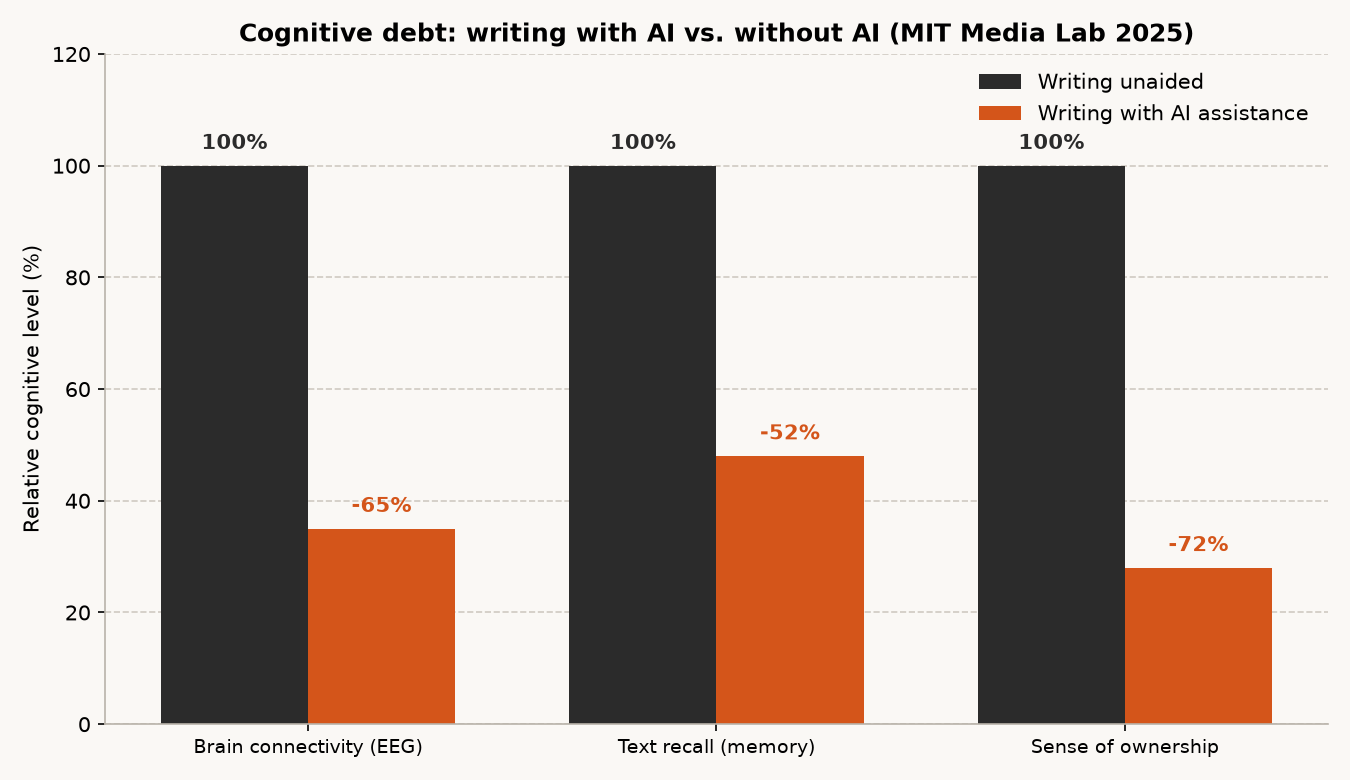
AI-assisted writing: brain connectivity −65 %, text recall −52 %, sense of ownership −72 %.
Key findings
Weaker brain connectivity
The AI-assisted group showed markedly lower coherent neural activity than the unaided group.
A retention problem
In follow-up testing, AI-group participants remembered substantially less of the information and argumentation in the text they themselves had signed and submitted.
Accumulating cognitive debt
The researchers coined the term cognitive debt: mental energy saved today thanks to AI, paid back tomorrow as an inability to recall information and integrate it into long-term memory.
What to do about it
Letting AI write an important email or report means giving up the memory trace for that topic. In the meeting afterwards, the details are simply not there.
- Actively rewrite the generated draft in your own words.
- Add your own examples and numbers from practice.
- When finished, answer out loud: „What is this document actually about?“
Source
Kosmyna, N., Hauptmann, E., Yuan, Y. T., Situ, J., Liao, X.-H., Beresnitzky, A. V., Braunstein, I., & Maes, P. (2025). Your Brain on ChatGPT: Accumulation of Cognitive Debt when Using an AI Assistant for Essay Writing Task. MIT Media Lab, arXiv:2506.08872. arxiv.org/abs/2506.08872
Comments
Loading comments…